Japan’s MMX launches to bring home samples from a Martian moon.
JAXA’s spacecraft has completed critical initial operations. Its Phobos sample return is targeted for 2031, with years of work still ahead.

Japan’s mission to bring material home from a moon of Mars is on its way—and its first critical spacecraft operations are complete. JAXA says the Martian Moons eXploration spacecraft, or MMX, was in good health following its October 20 launch.
An H3 rocket carrying MMX lifted off from the Tanegashima Space Center at 4:41:03 a.m. Japan time. JAXA confirmed that the rocket followed its planned flight and separated the spacecraft into the intended orbit 71 minutes and 13 seconds after launch.
The destination is Phobos, the larger of Mars’s two small moons. The ambition is extraordinary, but it is still an ambition in progress: MMX has not reached Mars, landed on Phobos or returned a sample to Earth.
The first hurdle was getting the spacecraft working
In an October 21 update, JAXA said the initial critical operation phase had ended successfully. The spacecraft deployed its solar-array paddles, established three-axis attitude control and released the hold-down mechanism for its medium-gain antenna.
These are engineering milestones rather than decorative items on a launch checklist. A spacecraft needs power, a stable orientation and the ability to communicate before it can carry out the long cruise and precise operations that follow.
The next phase is an initial series of functional checks as the mission prepares for its outbound journey. A healthy first update is encouraging, but it is not a guarantee that every later step will succeed. The mission still faces years of navigation, observations and surface operations.
Why a small moon carries such a large question
Phobos and Deimos look very different from Earth’s Moon. One central question is whether they began as captured objects or formed from debris associated with an impact involving Mars.
Observations from a distance can narrow possibilities, but a physical sample can expose details of composition and history that are harder to resolve remotely. That is why MMX is built around collecting material from Phobos and bringing it back for laboratory analysis on Earth.
The mission targets a return of at least 10 grams of material, according to ESA’s mission description. That sounds tiny beside the size of a spacecraft, but modern instruments can extract a great deal of information from carefully documented grains.
The route goes far beyond a launch-day photograph
The mission plan calls for reaching the Mars system in 2027, observing Phobos from a quasi-satellite orbit and studying Deimos remotely. Its programme also includes close surface work at Phobos and a rover contribution developed by the German and French space agencies, DLR and CNES.
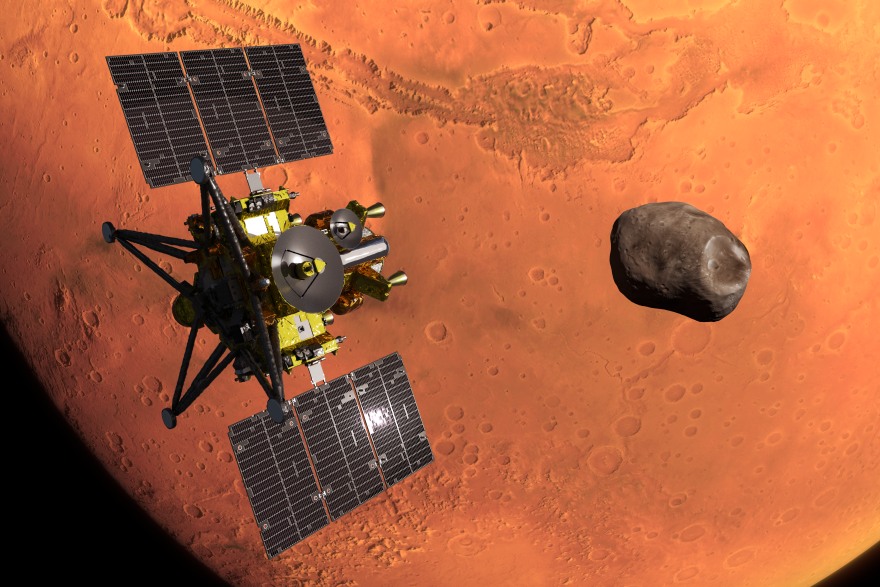
The planned sample return is in 2031. Dates for future mission phases are targets, not events that have already happened. Readers seeing a spacecraft illustrated beside Mars should therefore understand that image as a mission concept, not a photograph proving arrival.
The international effort includes contributions from NASA and European partners as well as JAXA’s leadership. Each part supports a chain of tasks in which launch is only the first major public milestone.
A moon sample is not a Mars surface sample
The distinction is easy to lose in a short headline. MMX is going to a moon of Mars. It is not the same mission as a rover drilling directly into the Martian surface, and its return would not by itself mean scientists had collected a pristine sample from a particular location on Mars.
Material on Phobos may nevertheless preserve clues relevant to the wider Martian system. Establishing where the moons came from would help researchers understand how that system formed and changed. The sample’s value depends on its context as well as its chemistry.
Nor does the mission’s launch amount to an announcement of life. The questions outlined in the official mission material concern origins, composition and planetary evolution. Any later scientific conclusions will require actual measurements and analysis.
What to watch next
The near-term updates will be about spacecraft checks and cruise performance, not an immediate landing. Later milestones will include arrival, detailed observations, the selection and execution of sampling operations, and finally the return journey.
For now, MMX has cleared an important opening stage: it launched, separated as intended and completed critical initial operations in good health. The mission’s biggest promise remains ahead—a small collection of grains that could answer a very large question about Mars’s two peculiar moons.