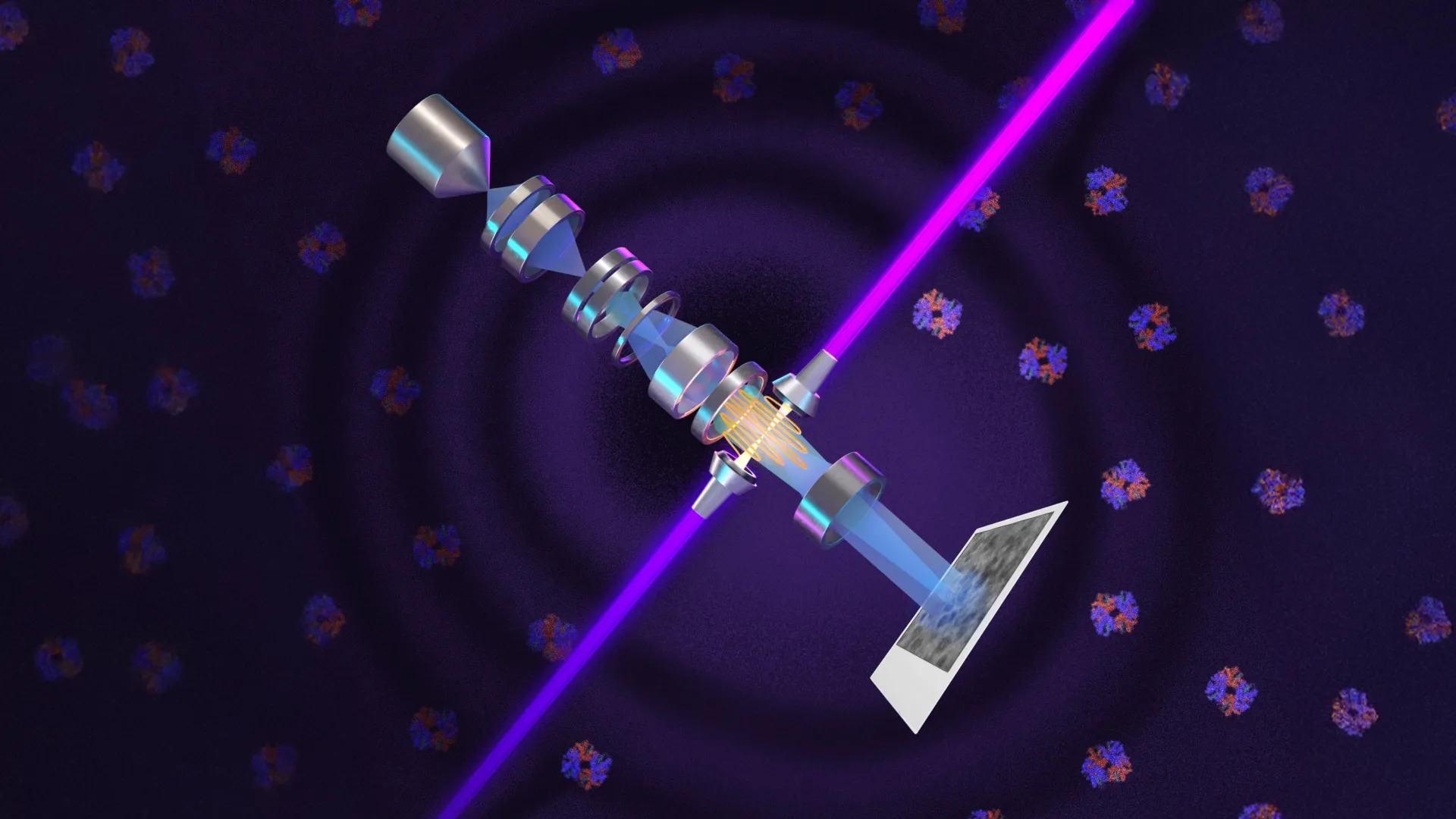
No tiny foreman. How a virus-like shell assembles itself, one piece at a time.
Oxford researchers watched reversible connections give way to stable molecular checkpoints. The antiviral possibilities remain a next step.
How does a protein shell build itself when no tiny foreman is directing the job? Oxford researchers followed an engineered virus-like particle as it grew and found a process that relies on reversible mistakes, followed by structures stable enough to lock progress in place.
The study, published in Nature and described in October 22 coverage, tracked assembly at the level of individual molecular additions. Its subject was a controlled virus-like particle system—not a demonstration that a new infectious virus had appeared. Potential vaccine and antiviral applications remain future uses of the insight, rather than treatments proven by this experiment.
The construction problem inside a microscopic shell
Many viruses protect their genetic material inside a protein coat called a capsid. The shape depends on how the building blocks connect. With many possible connections available, the puzzle is how components repeatedly find an organized structure rather than become trapped in useless arrangements.
A finished shell does not reveal every step that produced it. Short-lived intermediates can be rare, and a series of snapshots can miss the sequence between them. The Oxford team approached that problem by keeping growing particles observable and measuring changes as assembly unfolded.
Measuring growth without counting by eye
The researchers studied an engineered particle containing 60 protein units. Their technique combined mass photometry with a method for confining individual molecules so they could be followed repeatedly. Mass photometry estimates molecular mass from the light a molecule scatters.
As components joined a growing particle, the changing measurement allowed the team to infer additions and intermediates. This is not a conventional video in which a viewer simply watches recognizable bricks stack up. The useful information comes from quantitative optical measurements interpreted through a model of the assembly process.
Why weak connections can be an advantage
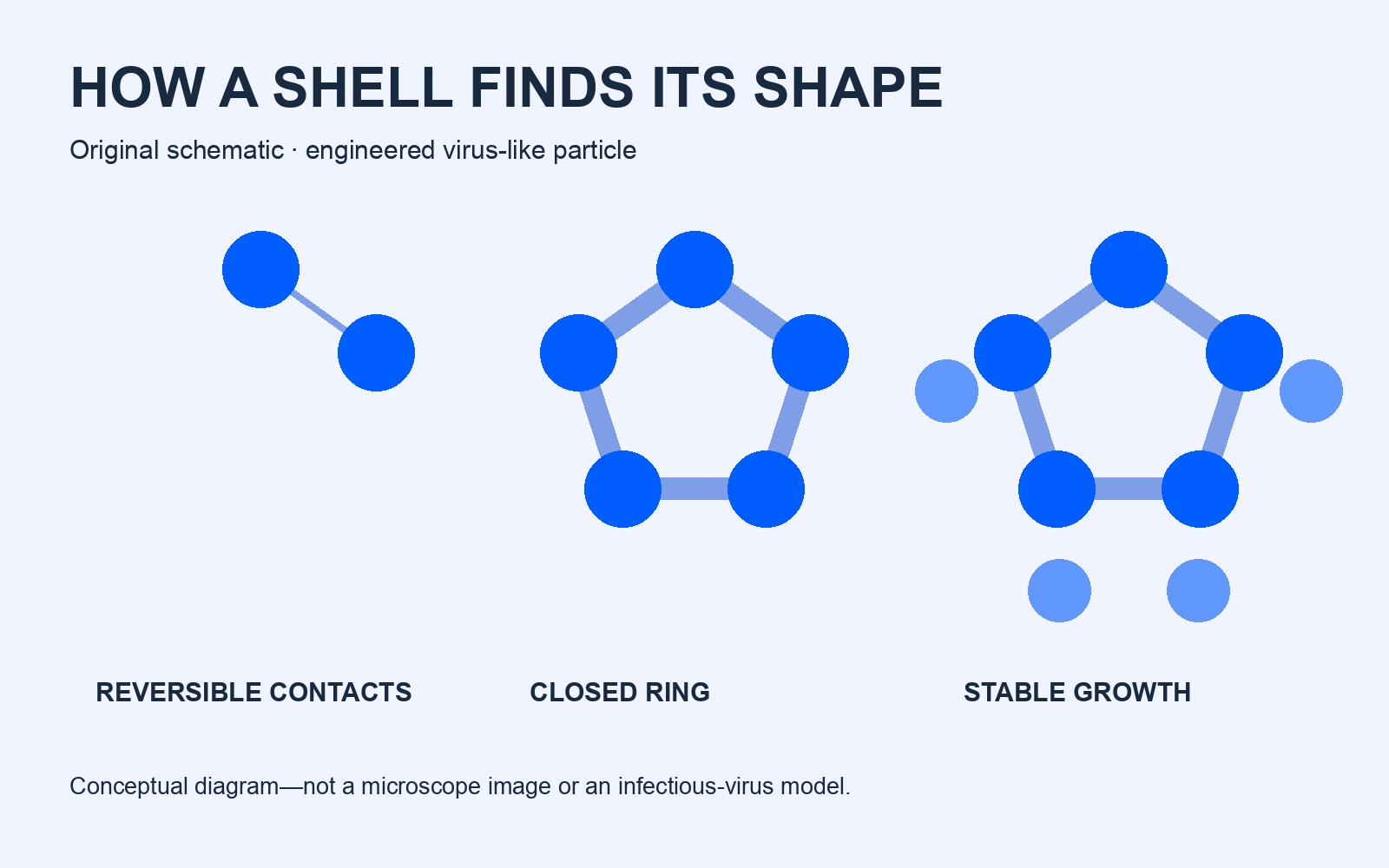
At the beginning, a protein component can join an arrangement and later leave it. Weak interactions make that reversibility possible. An unsuccessful connection does not necessarily ruin the whole structure; pieces can separate and try another arrangement.
That ability to backtrack is part of the solution, not evidence that the assembly is malfunctioning. If every early encounter locked permanently, incorrect structures could accumulate. A reversible early stage allows the system to explore possibilities before a more stable configuration emerges.
The pentagonal checkpoint
The researchers identified a particularly important stage when five larger building blocks formed a closed pentagonal ring. Multiple connections made that arrangement much more stable than the loose encounters that preceded it.
After the first stable intermediate formed, later stable stages required fewer additional building blocks. Growth could therefore proceed more efficiently. The result offers an explanation for a familiar feature of self-assembly: getting started can be difficult, but the structure can grow faster once a suitable nucleus exists.
The idea is not that the molecules understand a plan or intentionally correct mistakes. Their interactions are physical. The language of trial and error describes the pattern that emerges as components repeatedly attach, detach and settle into more stable arrangements.
What this could mean for medicine
If a particular interaction is essential for shell construction, it could become a point at which an antiviral strategy tries to interrupt the process. Conversely, understanding assembly could help scientists engineer virus-like particles for vaccines or other applications.
Those are research directions. The experiment did not establish a new medicine's safety, a vaccine's effectiveness in people or a universal rule for every virus. An engineered model can make a complex process measurable without reproducing all the conditions found inside an infected organism.
The broader advance is a way of investigating self-assembly while it happens. Similar questions arise in cellular scaffolds, molecular compartments and large protein complexes. Following the route—not just the destination—can reveal which interactions matter and which intermediate stages are worth testing next.
No foreman does not mean no biological information
The phrase self-assembly can sound as if order appears without any constraints. In reality, a protein's shape and its possible interactions help determine which structures can form. The experiment investigates how those physical properties produce an assembly route; it does not establish that genetic information is irrelevant to making the components.
There is also a distinction between a protein shell and a complete infectious virus. A laboratory system designed to study shell assembly is useful precisely because a selected process can be examined under controlled conditions. Results about those building blocks should not be reported as instructions for constructing an infectious agent, or as evidence that every stage of infection has been explained.
The next scientific questions include which interactions generalize to other particles, which depend on the chosen model and which can be altered predictably. Watching individual intermediates gives researchers a more direct way to ask those questions than looking only at an average of completed structures.