The world is heading past 1.5°C. A new UN report maps the difficult route back.
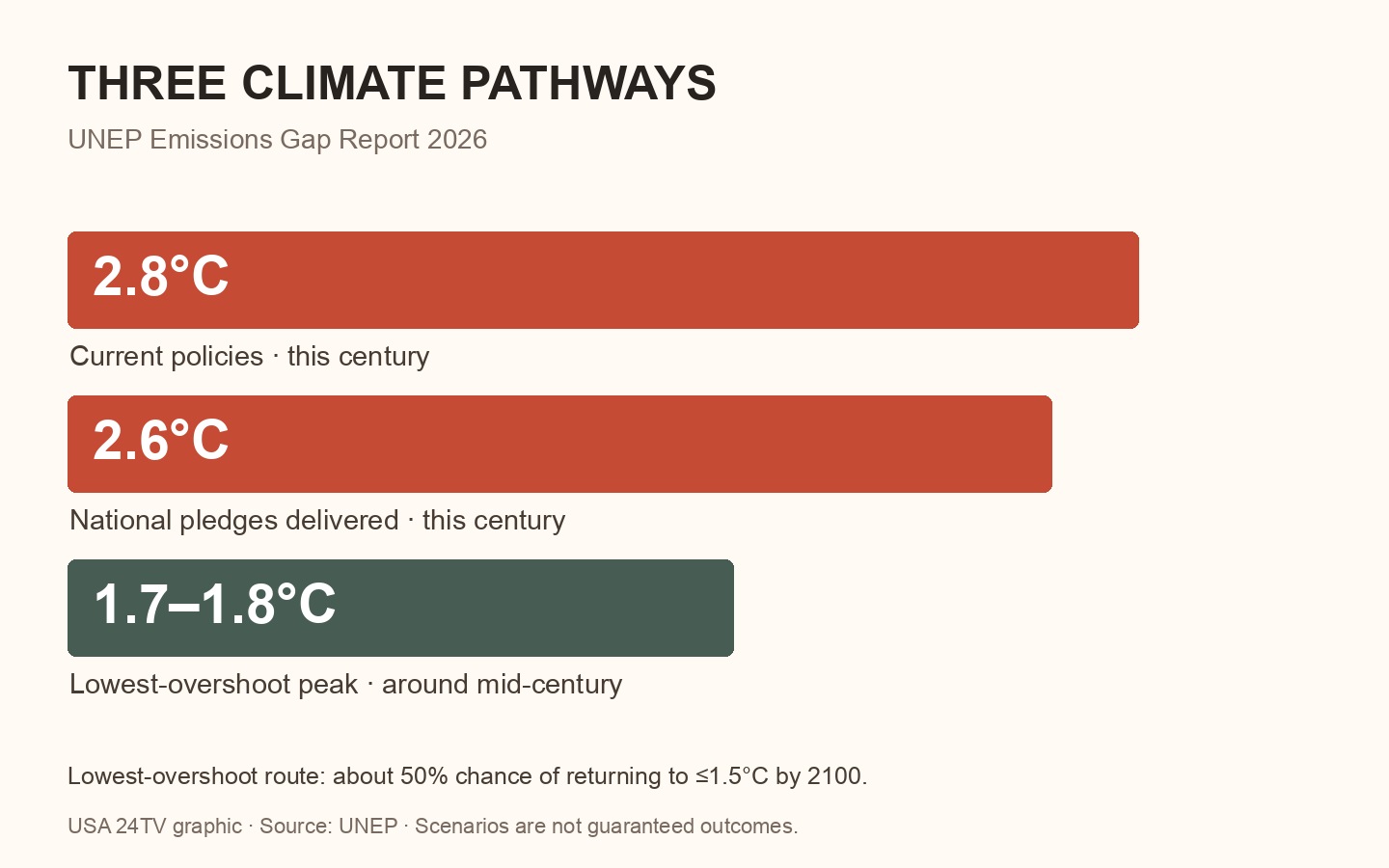
Current policies point toward 2.8°C this century, while the lowest-overshoot pathway requires much faster emissions cuts.
The world is heading beyond 1.5°C of warming, but the size and duration of that overshoot are still choices shaped by emissions cuts, the UN Environment Programme says in its new annual assessment.
The Emissions Gap Report 2026 sets out a demanding route back: cut global greenhouse-gas emissions 18% by 2030 and 45% by 2035, compared with 2025 levels, while expanding the removal and permanent storage of carbon dioxide through the century.
Its message is neither that the Paris climate goal is safely within reach nor that missing it temporarily makes further action pointless. More warming means more risk, and the report argues that limiting the peak remains urgent even as a return below 1.5°C becomes harder.
Three pathways, very different outcomes
Under policies currently in place, warming could reach 2.8°C within this century and continue increasing afterward. If countries fully deliver their national climate pledges and maintain similar efforts, the report puts the figure at 2.6°C.
Even the more optimistic case, which includes those pledges plus additional net-zero targets, would limit warming only to 2.1°C this century. These are scenario-based projections, not a declaration that one exact temperature is guaranteed regardless of what governments do next.
The distinctions are essential. A policy already operating is different from a national pledge, and a pledge is different from a longer-term target whose delivery remains uncertain. Combining them into one number would hide how much depends on future implementation.
UNEP says the projections are worse than the previous year's because of the United States' withdrawal from the Paris Agreement and revised estimates of historical emissions. New national pledges submitted since last year's assessment made a negligible difference to the projections.
What the lowest-overshoot route requires
The report's lowest-possible overshoot scenario limits peak warming around the middle of the century to 1.7–1.8°C, then returns temperatures to or below 1.5°C by 2100 with about a 50% chance.
Reaching that path requires emissions cuts of 18% by 2030, 45% by 2035 and 69% by 2040, measured against 2025. Full delivery of current national pledges would instead reduce emissions by only 5–8% by 2030 and 11–15% by 2035.
That is the emissions gap in practical terms: the reductions countries have promised are materially smaller than those required for the pathway the report examines. It is not enough to announce that emissions will eventually stop growing; the timing and depth of the cuts matter.
The scenario implies average annual reductions of 5.7% over 2025–2035. That is faster than the roughly 5% annual reductions in the older pathways described in the Intergovernmental Panel on Climate Change's Sixth Assessment Report.
Overshoot is not a harmless detour
UNEP Executive Director Inger Andersen warned that every additional fraction of a degree, and each extra year above 1.5°C, increases climate impacts and risks. The assessment points to floods, heatwaves and wildfires as the kinds of dangers that make limiting the peak consequential for communities.
Returning below a threshold later does not mean the period above it carries no cost. The report's focus on duration reflects that distinction: a shorter, lower overshoot is not equivalent to a higher temperature sustained for longer.
Delay also narrows the choices. UNEP estimates that every five years of carbon-dioxide emissions at current levels adds around 0.1°C to peak warming. It says keeping that peak below 1.7–1.8°C will quickly become impossible without urgent action.
Those findings do not amount to a forecast of one specific disaster in one specific city. They describe the increasing global risk associated with a warmer climate and the consequences of postponing reductions.
Carbon removal is part of the plan, not a guaranteed rescue
The lowest-overshoot scenario requires removing and permanently storing about 320 gigatonnes of carbon dioxide over the century. UNEP compares that with roughly eight years of global carbon-dioxide emissions at 2024 levels.
The scale is a reason for caution, not reassurance that emissions can be ignored now. The report says socioeconomic and technological challenges make it uncertain whether removal on that scale can be achieved.
Cutting emissions and removing carbon are therefore connected parts of the pathway. Depending on future removal to compensate for avoidable emissions today would place more weight on technologies, infrastructure and economic arrangements whose delivery is not assured.
There is evidence that policy can work
The report also documents progress. Renewable electricity capacity has grown three times faster than anticipated since the Paris Agreement, with solar photovoltaic deployment increasing seven times faster.
It draws on more than 220 policy evaluations. The electricity-sector policies evaluated reduced emissions by an average of 9%, while economic instruments such as carbon taxes and cap-and-trade schemes achieved reductions of 5–13% across sectors over the periods examined.
Those figures should not be read as automatic results for every country adopting a similarly named policy. UNEP says the successes remain concentrated in particular sectors, countries and periods. The challenge is to reproduce, extend and sustain them at a much larger scale.
The next test is implementation
Countries have already agreed through the first Global Stocktake to triple renewable-energy capacity and double the annual rate of energy-efficiency improvement by 2030, alongside other measures. The report says emissions indicators are still not declining at the pace needed to minimize overshoot.
The practical question is now whether governments translate the demonstrated progress in renewables and policy into faster reductions across energy, transport, methane and other sources. UNEP's assessment leaves room for a better outcome, but not for treating a future return below 1.5°C as something that will happen on its own.