US–Canada workplace survey finds a gap between AI confidence and staff experience
Ricoh’s company-sponsored survey says employees report more friction than decision-makers expect.
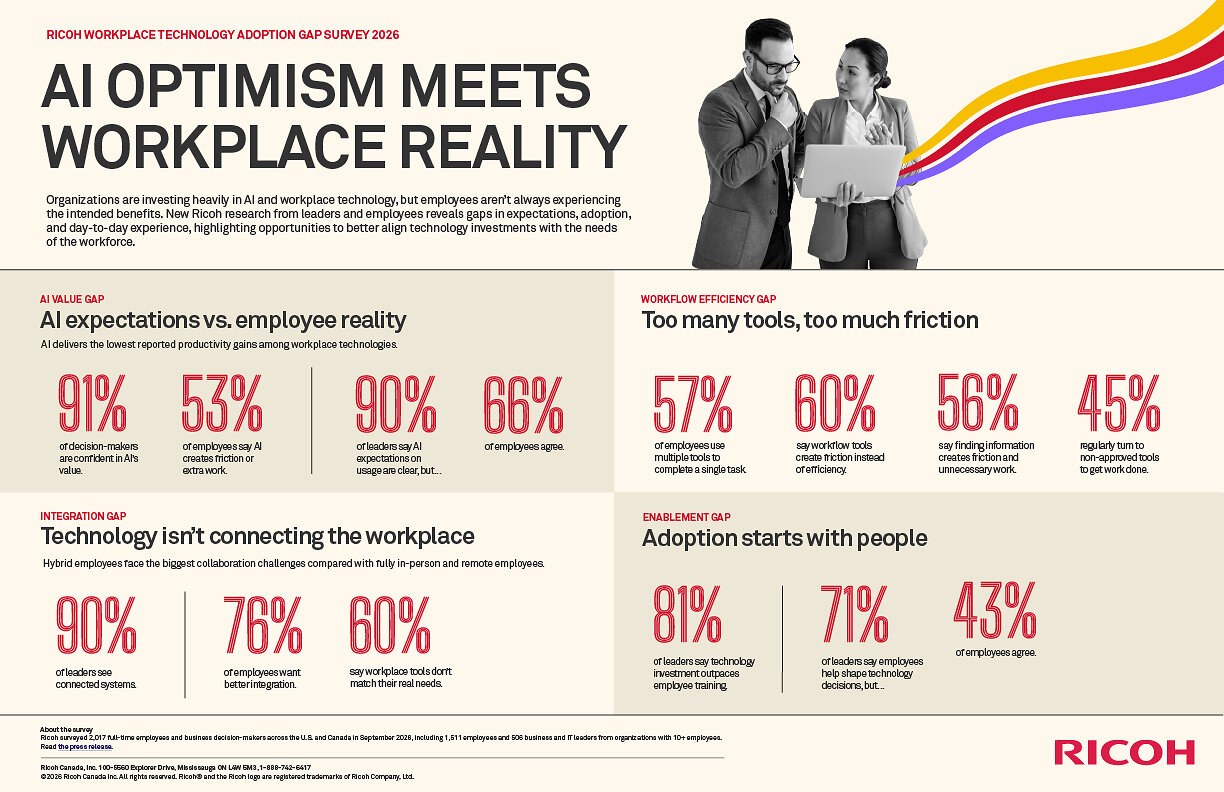
Business leaders are far more confident about the value of workplace AI than the employees using it, a new Ricoh survey suggests, exposing a gap between technology investment and the experience of getting everyday work done.
Among decision-makers surveyed in the United States and Canada, 91% said AI investments were delivering the value they expected. Yet 53% of employees said AI created friction or extra work, and 55% said managing workplace technology interfered with productivity.
The company-sponsored research covered 2,017 employees and decision-makers in total. The percentages describe different respondent groups, not a single set of people giving contradictory answers.
The bigger problem is disconnected systems
AI was only one part of the difficulty employees described. Sixty percent reported friction with workflow and process-management tools, while 56% said information and data-access tools added difficulty to their work.
The findings suggest that an individual application can look useful in a procurement decision while becoming less helpful when it has to work alongside other systems. Seventy-six percent of employees said their jobs would be easier if their organisation’s tools and processes worked together better.
Leaders often saw a more connected environment. Ninety percent of decision-makers believed their organisation’s tools, systems and processes were connected. On integration across departments, 70% of decision-makers gave a positive assessment, compared with 55% of employees.
Workarounds create another management challenge
When approved tools are difficult to use, employees may find alternatives. Forty-five percent said they used unapproved tools at least monthly to make work easier. That can leave employers with less visibility over where information goes and how tasks are completed, although the survey does not establish that those workarounds caused data breaches.
There was a similar divide over responsible AI. Ninety percent of decision-makers said employees had clear guidance, while 66% of employees agreed. A written policy and guidance that staff can confidently apply are not necessarily the same thing.
Hybrid work exposes a different part of the gap
The survey also found differences linked to working arrangements. A quarter of hybrid employees reported difficulty collaborating with colleagues in other locations, compared with 16% of fully in-person employees and 14% of fully remote employees. The figures describe reported experiences rather than proving that one working model is always more effective than another.
They do, however, widen the question beyond the choice of an AI product. People can have access to the same applications while relying on different processes for finding information, handing over work and reaching colleagues. A deployment that looks complete from an IT inventory may still leave those practical steps unresolved.
For employers, the contrast points towards measuring whether tasks become easier after a rollout, not only whether licences have been purchased or accounts activated. It also raises the importance of comparing leadership expectations with employee experience. The survey cannot calculate a particular company’s return on investment, but it identifies the kinds of operational questions that a headline adoption figure alone would miss.
Buying faster than people can adapt
Eighty-one percent of decision-makers acknowledged that their organisations invested in workplace technology faster than they helped employees learn to use it. Only 43% of employees said their input was usually sought before a rollout, compared with 71% of decision-makers who believed that happened.
The findings do not prove that AI reduces productivity in every workplace. They reflect reported experiences, and Ricoh sells services in the market being studied. The practical question raised by the survey is narrower: whether a deployment removes work for employees or simply adds another tool they must manage.