Outside the cone does not mean safe. The hurricane-map mistake that persists.
An FSU study found that a clearer inland watch graphic did not automatically change risk perception or plans to prepare.
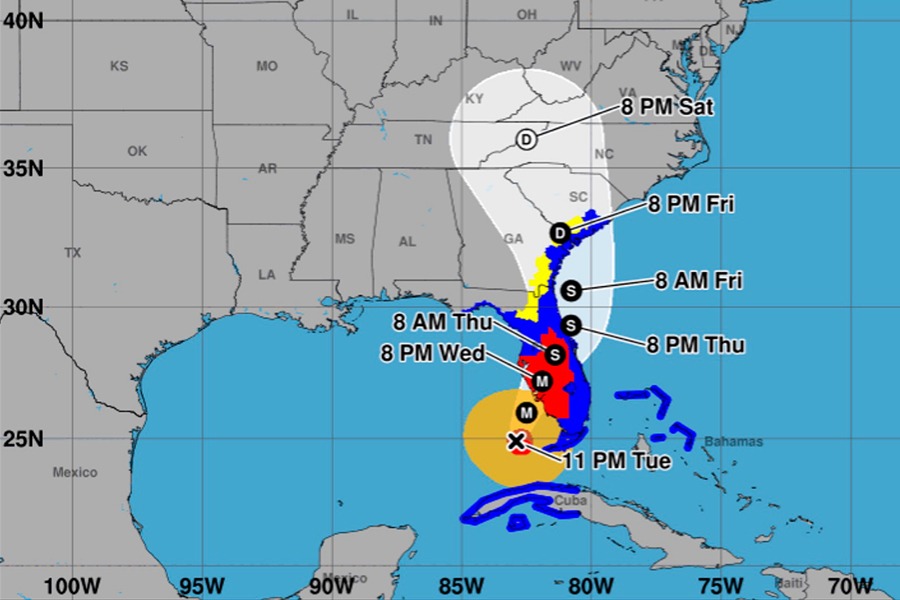
Being outside a hurricane forecast cone does not mean being outside the danger. The cone describes uncertainty in the future position of a storm's centre. It is not a boundary enclosing all damaging wind, flooding, tornadoes or storm surge.
A Florida State University study offers a second warning: adding useful information to a map does not automatically change how people respond. An experimental graphic helped nonexperts identify inland watch areas more accurately, but did not significantly change their perceived risk or intentions to take protective action. FSU published its account on August 11; October coverage brought renewed attention to the findings.
What the white shape actually tells you
The National Hurricane Center constructs the cone around a forecast track using circles based on historical track errors. Its definition says each circle is sized so that two-thirds of the relevant historical errors fall within it. The resulting shape communicates uncertainty about the centre's track over time.
A wider portion of the cone is therefore not a picture of a physically larger hurricane. It reflects greater uncertainty at that forecast lead time. Likewise, the edge is not a wall that prevents hazards from crossing into places outside it. A large storm and a small storm can both have impacts far from their centres.
Why inland warnings were added
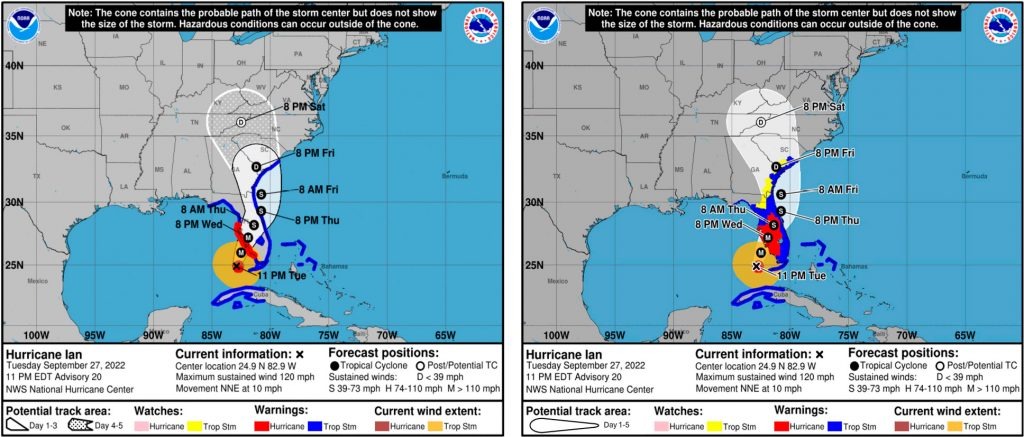
The experimental graphic studied by the FSU team includes inland tropical-storm and hurricane watches and warnings alongside the track cone. The change was designed to make information beyond the immediate coastline easier to see.
That is important because a storm can create serious problems after moving inland. Flooding, destructive winds and tornadoes are not restricted to beaches. A person who knows they do not live in a coastal evacuation zone may still need to understand rainfall forecasts, local warnings and other instructions for their specific area.
Recognizing a watch is not the same as taking action
Researchers surveyed participants in Florida and Georgia, comparing responses to conventional and updated graphics. People who saw the revised version were better at recognizing locations covered by watches. They were not better at identifying warning regions, and the clearer watch information did not produce stronger stated intentions to prepare.
Those distinctions matter. A finding about watches should not become a headline claiming every type of warning was understood better. Nor did the survey directly measure how every participant behaved during an actual landfall. Intentions reported in a study and protective actions taken during an emergency are related questions, not interchangeable outcomes.
The forecasting science was not the target
The authors emphasized that the study was about communication rather than whether the National Hurricane Center can forecast storms. Their concern was how people interpret complex information and connect it to decisions.
A map can be accurate and still be misunderstood. Conversely, difficulty understanding a graphic is not evidence that a forecast should be ignored. The practical response is to combine the track information with local hazard forecasts and instructions, rather than choose a single image and treat it as a complete safety assessment.
A useful question to ask about your own location
Instead of asking only whether your town falls inside the cone, ask what impacts are forecast where you live, work or intend to travel. Check current National Weather Service and National Hurricane Center products, local emergency-management messages and any evacuation orders.
The map reproduced with this report is a research example, not a live forecast. Its storm label, colours and dates must not be circulated as an active warning for this edition. This article does not announce a new hurricane landfall. It explains why the shape people recognize most quickly may be only one part of the information they need.